
Why MH-SPACE?
Australia’s frontline community pharmacy workforce can do more to support the health and wellbeing for Aboriginal and Torres Strait Islander people. This project focuses on upskilling pharmacists, who are trusted, accessible healthcare professionals, to provide mental health support for First Nations people.
Pharmacists are highly trusted and accessible healthcare providers in Australia. However, there are significant gaps in education relating to both Aboriginal and Torres Strait Islander peoples’ health and wellbeing in pharmacy curricula (Burke et al., 2024; De Zilva et al., 2022; Welch et al., 2020).
MH-SPACE aims to address these gaps by providing education and assessment materials to pharmacists so that they can better support Aboriginal and Torres Strait Islander peoples in a culturally safe and responsive manner.
What will happen during the MH-SPACE Trial?
The MH-SPACE project involves delivery and evaluation of a training package, comprised of existing and new materials developed with Aboriginal and Torres Strait Islander people, for community pharmacy staff to better support the mental health of Aboriginal and Torres Strait Islander peoples.
The training package will be evaluated through a Randomised Controlled Trial. Participating community pharmacies from Western NSW, NT, the Pilbara, and the Kimberley will be randomised to either the intervention or comparator group. All participating pharmacies will receive covert simulated patient visits (mystery shops) by actors before and after the training is delivered to the intervention group, and performance will be compared.
The primary outcome is the proportion of simulated patients who receive appropriate mental health support, first aid, and referral during the final visit. Pharmacy staff will also complete questionnaires to explore self-reported constructs. Qualitative data collection from pharmacy staff, community members and actors will also be undertaken.
Evaluation
The MH-SPACE training package will be co-designed, and content validated by stakeholders in Aboriginal and Torres Strait Islander mental health.
The evaluation of the project’s impact is conducted with Aboriginal people (i.e. project team members) and overseen by Aboriginal and Torres Strait Islander people (i.e. First Nations Strategy Group members).
The primary outcome is the proportion of simulated patients who receive appropriate mental health support, first aid, and referral during the final visit.
It is envisaged that should the evaluation demonstrate that the training is effective, then pharmacy educators and continuing professional development providers may choose to use some or all of the MH-SPACE training package and/or scenarios (and associated rubrics) in the education and training of pharmacy students and pharmacy staff.
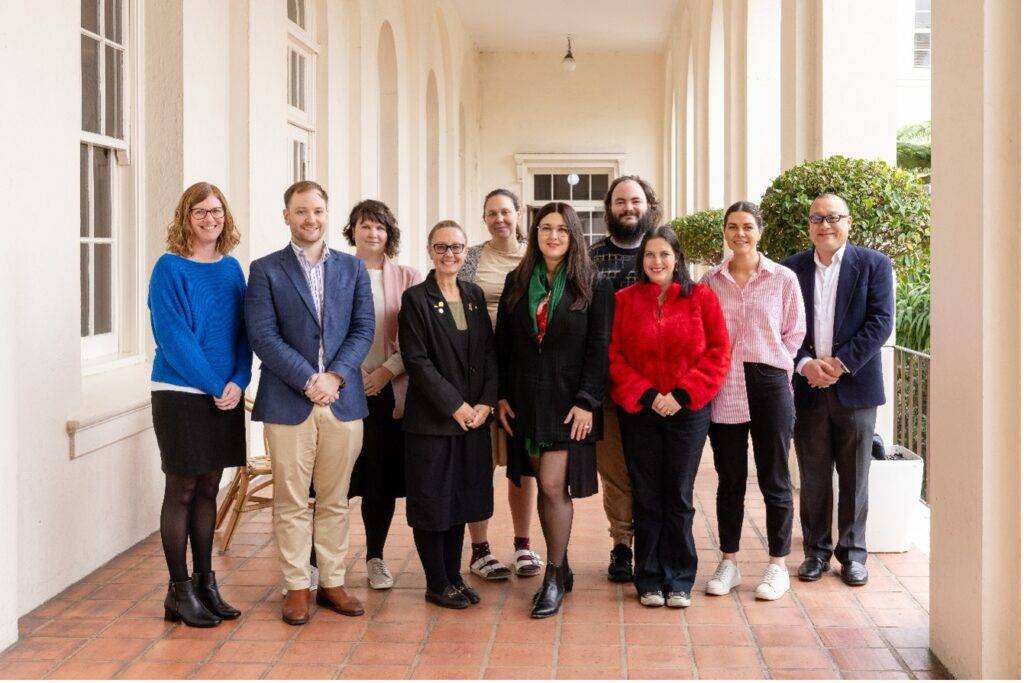
Funding Partners and Collaborators
We acknowledge the support from our project partners:






References
Burke, A. W., Saini, B., Maundu, J., Clark, B., Wilkinson, G., & Moles, R. J. (2024). Exploring First Nations’ and Cultural Safety Content of Pharmacy Curricula With Academics in Australia. American Journal of Pharmaceutical Education, 88(1). https://doi.org/10.1016/j.ajpe.2023.100605
De Zilva, S., Walker, T., Palermo, C., & Brimblecombe, J. (2022). Culturally safe health care practice for Indigenous Peoples in Australia: A systematic meta-ethnographic review. Journal of Health Services Research & Policy, 27(1), 74-84. https://doi.org/10.1177/13558196211041835
Welch, S., McMillan, F., & Moles, R. (2020). Hospital pharmacy services supporting Aboriginal or Torres Strait Islander peoples in Australia: a systematic review. Journal of Pharmacy Practice and Research, 50(3), 191-204. https://doi.org/https://doi.org/10.1002/jppr.1666